
KTN Optical Deflector
High-speed (100 kHz) optical deflector with no moving parts
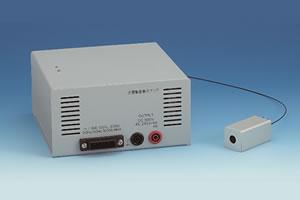
What is KTN crystal?
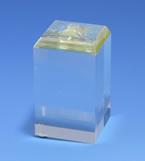
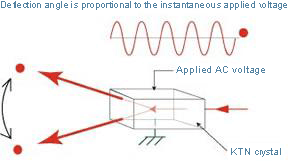
"KTN crystal" is an oxide crystal made from potassium (K), tantalum (Ta), and niobium (Nb). By utilizing the property of KTN crystal that "the refractive index can be freely changed by applying voltage," it is possible to freely control the direction of incident laser light.
Overview
Since KTN crystals were first reported in the 1950s, they have been known for their enormous electro-optical effects, but their industrial applications have not progressed until now. The reason for this is that it was extremely difficult to grow large, high-quality crystals. In 2007, NTT Photonics Laboratories (at that time) established a crystal growth technology that could be used as an optical device. Furthermore, through further research on the physical properties of KTN crystals, we discovered the world's first "space charge control electro-optic effect" that controls the refractive index of crystals using a new principle, realizing a high-speed, compact optical deflector with no moving parts.
feature
High-speed scanner with 100 kHz operating speed
Since there are no mechanical moving parts and the direction of laser emission is controlled by an external electric field, high-speed operation more than 100 times faster than conventional products (galvanomirrors, polygon mirrors, etc.) is possible. For example, in the medical field, if it is applied as a light source for optical coherence tomography (OCT), diagnosis can be made faster than before, which is expected to reduce the burden on patients.
Achieves compact size
It has a simple structure in which electrodes are formed on a KTN crystal, and the chip size is extremely small, only a few millimeters square. increase.
Capable of operating over a wide wavelength range
KTN crystals are transparent in the wavelength range of 488 to 3500 nm, making it possible to implement devices over a wide wavelength range. We sell visible light, 1.0, 1.3, and 1.5 μm band deflectors as standard specifications. Please inquire about special wavelengths.
Product lineup
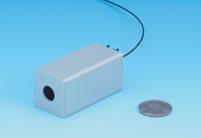
1D KTN optical scanner (fiber input type, spatial input type, mount type)
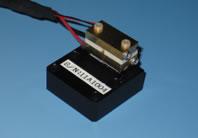
Specification
| Wavelength | Visible | 1.0 μm Range | 1.3 μm Range | 1.5 μm Range |
|---|---|---|---|---|
| Deflection Angle | 150 mrad | 120 mrad | ||
| Driving Frequency | 10-100 kHz | |||
| Entrance Aperture | 1.0 mm × 1.0 mm (spatial input type) | |||
| Output Beam Diameter | ~ 0.4 mm (for incident beam diameter 0.5 mm) | |||
| Size | Module 23×23×50 mm Mount 25×25×38 mm |
|||
2D KTN optical scanner (fiber input type, spatial input type)
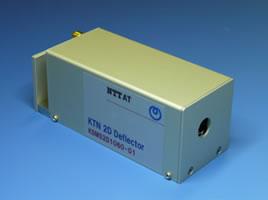
Specification
| Wavelength | Visible | 1.0 μm Range | 1.3 μm Range | 1.5 μm Range |
|---|---|---|---|---|
| Deflection Angle | 120 × 96 mrad | |||
| Driving Frequency | 10-100 kHz | |||
| Entrance Aperture | φ1.0 mm (spatial input type) | |||
| Output Beam Diameter | ~0.4 mm (for an incident beam diameter of 0.5 mm) | |||
| Size | 40×40×100 mm | |||
2D KTN optical scanner (handheld type)
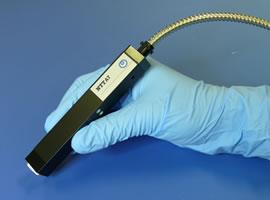
Specification
| Wavelength | Visible | 1.0 μm Range | 1.3 μm Range | 1.5 μm Range |
|---|---|---|---|---|
| Deflection Angle | 120×120 mrad | |||
| Driving Frequency | 0.1~20 kHz | |||
| Output Beam Diameter | ~ 0.8 mm (for incident beam diameter 0.5 mm) | |||
| Size | 16×16×114 mm | |||
| Weight | 60 g | |||
Linear amplifier (DC to 3 kHz 1-channel/2-channel type, 20 kHz type)
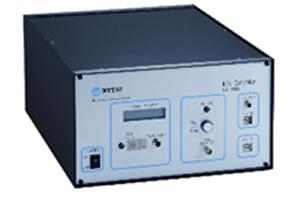
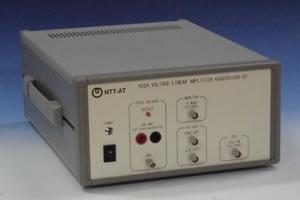
Specification
| Model number | KST1000A | KST1000B | KAS0201CH |
|---|---|---|---|
| Frequency | DC to 3 kHz (*1) | 20 kHz (10 kHz to 30 kHz (*3)) | |
| Output Voltage | ±600 V (*2) | 283 Vrms | |
| DC Bias Output | - | 0-500 V | |
| Signal Input Voltage | ±10 | - | |
| Output Voltage Waveform | - | sine wave | |
| Number of Output Channels | 1 | 2 | 1 |
| Number of Peltier Controller Channels | 1 | 2 | - |
| Input Voltage | AC 100-230 V / 48-62 Hz | ||
| Interface | - | RS-232C (*4) | |
| Dimensions *excluding protrusions | 320×430×177 mm | 260×350×150 mm | |
*1 : Characteristics at no load.
*2 : Output voltage can be changed. Please contact us for more information.
*3: A separate external input signal is required.
*4 : A separate control PC is required. (Please contact us for sample programs.)
Resonant power supply (100 kHz type, 200 kHz type)
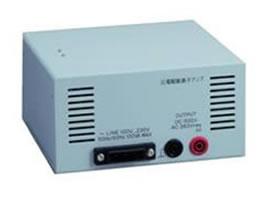
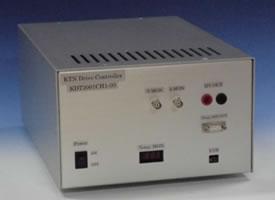
Specification
| Model number | KPS1001CH | KPS2001CH | KDT2001CH |
|---|---|---|---|
| Frequency | 100±5 kHz | 200 kHz±100 ppm | |
| Output voltage (*1) | ±400V | ±450V | |
| DC Bias Output | ±500V | ±600V | |
| Signal Input Voltage | - | - | - |
| Output Voltage Waveform | sine wave | ||
| Number of Output Channels | 1 | 1 | 1 |
| Number of Peltier Controller Channels | - | - | 1 |
| Input Voltage | AC 100-230 V / 48-62 Hz | ||
| Interface | RS-232C (*2) | ||
| Dimensions *excluding protrusions | 150×150×75 mm | 246×350×148 mm | |
*1 : Characteristics of capacitive load (1nF to 2nF).
*2 : A separate control PC is required. (Please contact us for sample programs.)
KTN Optical Scan Example
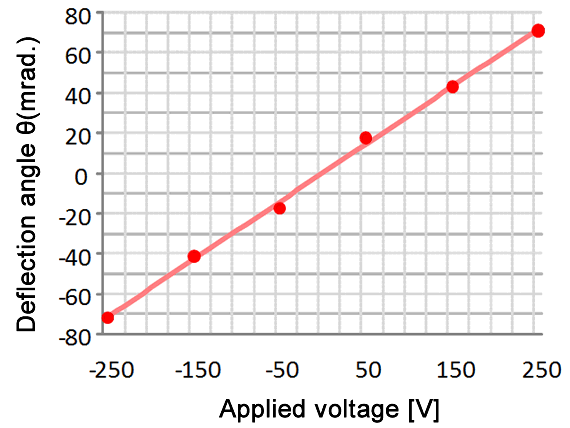
Relationship between deflection angle and applied voltage in KTN optical scanner
This is an experimental example of scanning a laser beam with a wavelength of 633 nm at 100 kHz using a one-dimensional KTN optical deflector. This is a graph showing the relationship between AC voltage and deflection angle when a DC voltage of 150 V is applied to the KTN crystal.
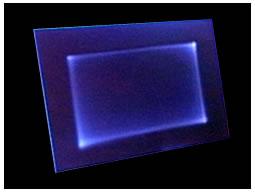
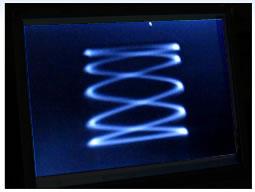
Examples of scans using a 2D optical scanner
KTN 2D scanner video
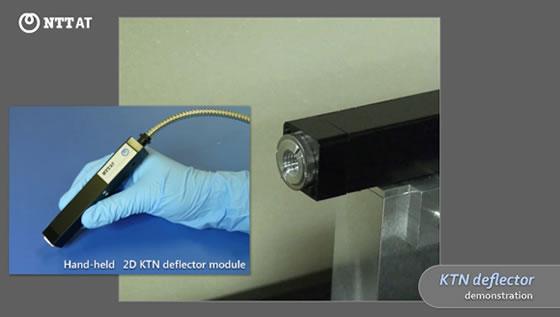
A video of the KTN optical deflector(in English) is introduced. Play time: 03 minutes 04 seconds
Application example
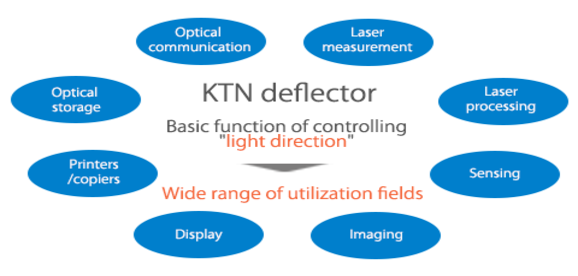
- Optical coherence tomography (OCT)
- Endoscope
- Precision surveying system
- Laser microscope
- Laser processing
- Laser Marker
- Optical switch
Related information/News releases, etc.
Winner of the Grand Prize at the CLEO/Laser Focus World Innovation Awards.
The CLEO (the world's largest international conference on laser and optical technology)/Laser Forcus World Innovation Award recognizes innovative products and technologies in the field of laser science, and is the first Japanese company to receive the grand prize. .
-
2017/ 01.24
Highly stable light source for thickness measuring devices developed using wavelength tunable technology with KTN crystals (joint development result with Hamamatsu Photonics, NTT, and NTT-AT)
-
2017/ 02.15
Developed a new position measurement system (optical sweeping position measurement technology) (developed by IREC Giken and NTT-AT)
-
2017/ 04.14
World's first successful 3D imaging of biological tissue using a rigid endoscope (Joint development result of NEDO, Osaka University, and NTT-AT)