
intelligent light switch
Optical Line Switching Equipment Backbone Highly Reliable Redundant Configuration Solution
What is an optical switch?
An optical switch, also known as an optical line switching device (automatic switching type optical patch panel), is a device that enables the network to be always connected.
Any communication protocol (Ethernet, ATM, etc.) or communication speed (1GbE, 100GbE, etc.) can be used.
Optical switch lineup list
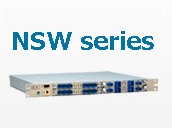
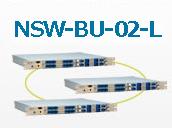
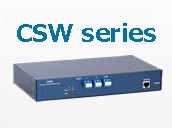
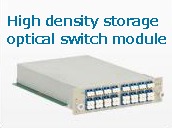
Three advantages of optical switches
Significant reduction in network downtime
Detects network failures due to power drop and automatically switches paths*
Manual switching takes time. It can be switched automatically using an optical switch.
By using optical switches for equipment redundancy and transmission line redundancy, it is possible to significantly reduce network interruption time.
![[✕] In the event of a failure, manual route switching takes time, such as "running to the site" and "connector replacement work".](https://data.wovn.io/ImageValue/production/624d32c0205c3e139a304018/en/624d32c0205c3e139a304018.1796670809.1664843115986.png)

![[○] If a failure occurs, it can be switched automatically by using an optical switch. (Switching is automatically performed by detecting light interruption *1, switching time is 10 milliseconds or less *2)](https://data.wovn.io/ImageValue/production/624d32c0205c3e139a304018/en/624d32c0205c3e139a304018.undefined.1664843415436.png)
Automatically detects light outage and switches over *1
Switching time: 10 ms or less *2
*1 The automatic switching function is only compatible with modules with a light detection function.
*2 Threshold for automatic switching judgment and protection time can be set.
Remote monitoring and control possible
Web user interface, SNMP, CLI (TELNET/SSH), etc. allow remote monitoring and control.
Continuously monitors optical power in-line with detection levels from -40dBm to +10dBm.
By monitoring the optical power of the standby system, the risk of failure is reduced.

Risk reduction possible
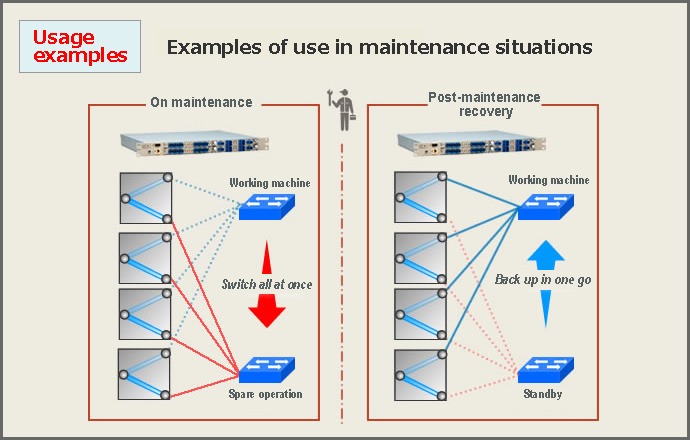
- Human error reduction
- By switching the path using an optical switch, you can switch at once without making mistakes such as incorrectly inserting the optical fiber connector or staining the connector end face.
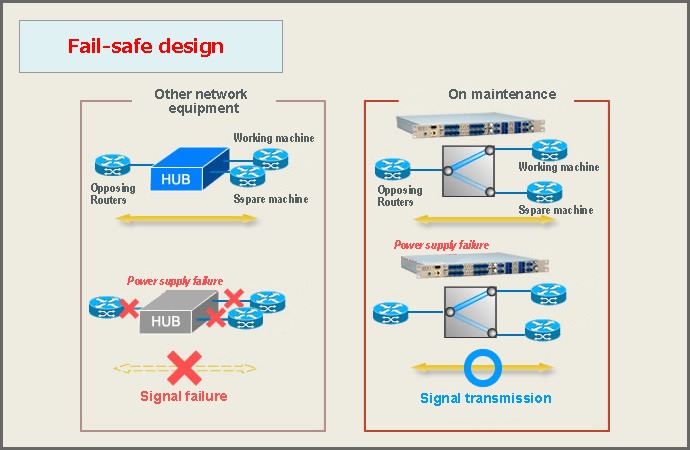
- Fail-safe design
- Because it is a passive type optical switch, even if a failure occurs in the power supply or control system of the optical switch, the communication state of light is ensured.
Optical switch features
It does not require any network type or communication speed (bandwidth).
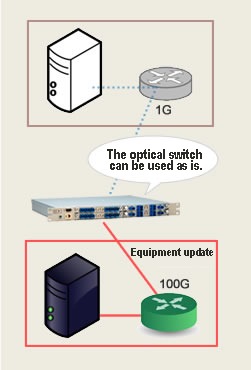
Because it is an optical fiber switch (which physically switches the optical path), the type of network to connect to (*1) is not limited as long as it is an optical interface.
In addition, since there is no limit on communication speed, the same model can be used with either 1GbE or 100GbE.
Therefore, even if you change the network equipment or its interface, you can continue to use the optical switch as it is.
*1: Ethernet, ATM, SONET/SDH, MPEG-2TS, etc.
High reliability
Highly reliable optical switch parts are used.
| Number of FITs (failure in time) | 60 |
|---|---|
| switching times | 10,000,000 times or more |
Self-maintaining function: The state is maintained even if a power outage (failure) occurs.
Switching time is within 10msec
Group linkage function (*3)
It is possible to switch switches that have been grouped in advance in a linked manner.
When one optical switch switches for some reason, the optical switches in the same group also switch, supporting ring aggregation.
*3: The interlocking function is available only for the NSW series.
![Introduction of functions: [Group interlocking function] Interlocking switching of pre-grouped switches is possible.](https://data.wovn.io/ImageValue/production/624d32c0205c3e139a304018/en/624d32c0205c3e139a304018.1796670817.1665639930285.png)