
Attenuation of radio waves during sleet and melting snow
Will there be radio interference when spring approaches?
When the antenna surface is treated with Super hydrophobic...
Compared to cases where a water film is formed without Super hydrophobic treatment, radio wave attenuation can be reduced.
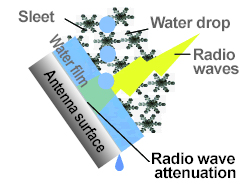
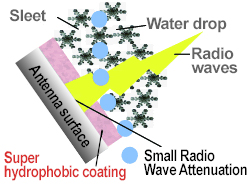
The figure below shows the calculated radio wave attenuation when a large amount of moisture is retained in the snow during sleet, etc., and a thick water film (0.5 mm, 1.0 mm) is formed.
As shown in the figure, even in low-frequency regions where the effect of the water film is not considered to be very significant, a thicker water film causes attenuation that does not occur with normal rainfall.
The same applies to snowmelt as to sleet. When a thick film of water forms, attenuation occurs.
(supplement)
Radio wave attenuation due to ice is very small compared to water. Since snow is a mixture of ice and air, snow attenuation is less than ice attenuation.
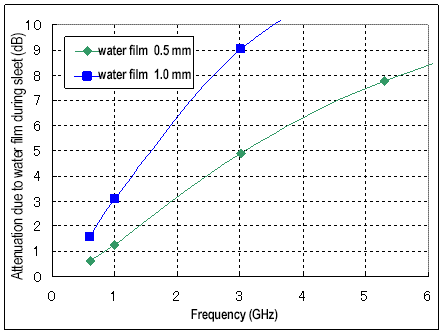
*Data below 3GHz was calculated using the refractive index and absorptivity of water at 3GHz, with the temperature assumed to be 0°C.